The Technology Behind the Experience: Why Smart Platforms Win Without Announcing It
Updated: 19 Jul 2026
40
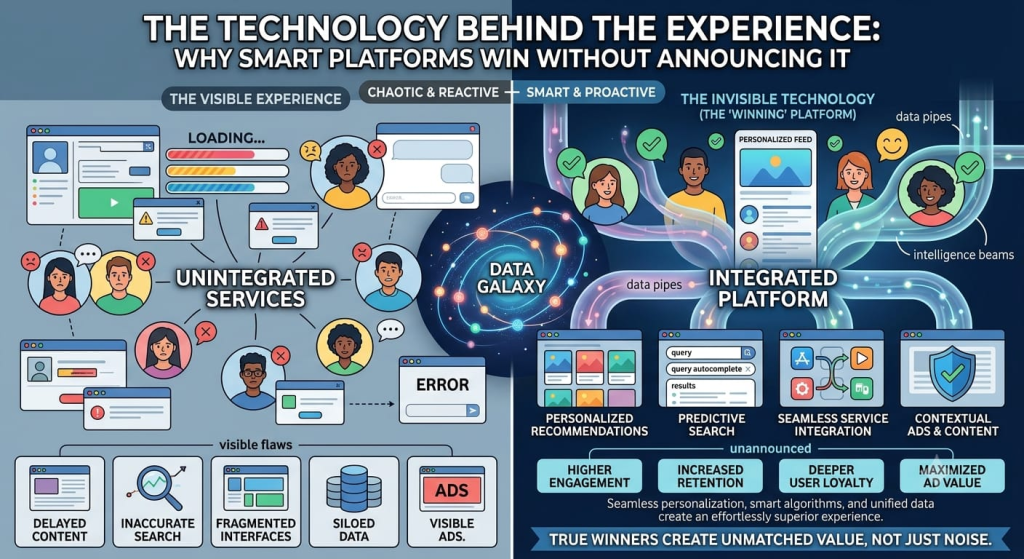
The most useful technology tends to be the kind you stop noticing. You remember the first time a streaming app loaded instantly and you thought about it. You don’t think about it anymore, because it keeps doing it. The expectation absorbed itself into the baseline and the technology became invisible. That’s what successful platform engineering actually looks like from the outside: nothing to report.
This is harder to build than it sounds. Invisible good experiences require coordinated work across networking, rendering, data architecture, and interface design, with each layer performing well enough that none becomes the thing a user notices. Any single layer failing conspicuously breaks the illusion. The discipline required to keep all of them performing simultaneously, continuously, across an unpredictable range of devices and network conditions, is substantial.
The digital entertainment industry has been running this race for over a decade. The platforms that are still growing are the ones that got the invisible infrastructure right, then kept improving it while their competitors were distracted by more visible features.
Intelligence Embedded in the Product vs. Intelligence Announced as a Feature
There’s a version of AI in entertainment products that announces itself constantly. ‘AI-powered recommendations!’ ‘Smart suggestions just for you!’ ‘Personalized by machine learning!’ These announcements are usually a signal that the underlying system isn’t quite confident enough in its recommendations to let them speak for themselves.
The better version of intelligence in entertainment products doesn’t announce itself at all. The queue on your streaming app populates with things you’d actually want to watch. The game surfaces the activity that suits the time you have available. The discovery section shows you something you hadn’t seen before but immediately recognize as exactly your kind of thing. You might not attribute any of this to ‘AI.’ You’d just think the product was good.
That unannounced intelligence is considerably harder to build than the announced kind, because it depends on both technical quality and design judgment about what to show. A technically accurate recommendation that’s shown at the wrong moment in the wrong context still produces a poor experience. Getting both dimensions right simultaneously, at scale, for millions of users with different habits and schedules, is where the real product work lives.
The Context Signal That Most Platforms Leave on the Table
Time of day is one of the most reliable behavioral signals in entertainment consumption, and most personalization systems either ignore it or use it crudely. A person who watches intense crime dramas on Tuesday evenings and lighthearted cooking videos on Saturday mornings isn’t expressing contradictory preferences. They’re expressing context-dependent ones that most systems conflate into a single preference profile and then wonder why the recommendations feel slightly off.
Session length is another. Someone with six minutes before a meeting and someone with two hours on a Sunday afternoon are nominally the same user with the same content history. What they want from the product in those two moments is genuinely different. Platforms that detect session context and adjust what they surface accordingly are serving the actual user rather than an averaged version of their past behavior.
Cloud Infrastructure: The Part Nobody Celebrates Until It Fails
Cloud infrastructure has been one of the most significant enablers of modern digital entertainment and one of the least celebrated, probably because good infrastructure is genuinely invisible. You don’t notice that you’re accessing content from a server 40 kilometers away rather than 4,000 kilometers away. You notice if the CDN was poorly configured and a simple page takes eight seconds to load, but you attribute that to ‘the app being slow’ rather than to a geographic routing decision made by an infrastructure team.
The practical improvements cloud infrastructure has enabled in entertainment over the past decade are substantial. Dynamic scaling during demand spikes means a popular game launch or a streaming premiere no longer necessarily ends in server failure. Content delivery networks distributed geographically mean that users in different parts of the world get comparable performance rather than dramatically unequal experiences depending on where the nearest server happens to be.
Continuous deployment has changed the product update rhythm in ways that benefit users directly. A bug that would have required waiting for the next scheduled patch release can now be fixed and deployed within hours. New features can be tested on a subset of users, validated, and rolled out progressively rather than shipped to everyone simultaneously with crossed fingers.
Browser Technology Solved a Distribution Problem Quietly
The browser went from an entertainment limitation to an entertainment delivery platform so gradually that most people didn’t register the transition. Early browser-based entertainment was genuinely constrained: limited graphics capability, unreliable audio, no persistent connections for multiplayer, slow JavaScript execution. These weren’t excuses. They were real technical walls.
HTML5 pulled most of those walls down. WebGL brought GPU-accelerated graphics to the browser. Web Audio gave developers a proper audio pipeline. WebSockets opened persistent low-latency connections for real-time experiences. WebAssembly allowed code originally written for native applications to run in a browser at near-native speed. The browser became a capable runtime, not a compromise.
The distribution consequence of this matters as much as the quality improvement. A browser-based experience reaches anyone with a link and a modern browser, without asking them to download anything, create an account, or store anything on their device. The friction between a potential user and a first experience dropped close to zero. Most people don’t notice this at first, but the conversion data absolutely reflects it.
What Users Actually Evaluate When They Evaluate a Platform
Ask users to rate a digital entertainment platform and they’ll mention content, price, and interface. Observe their actual behavior and the pattern that predicts whether they return is more granular than any of those categories. It’s about specific friction points: whether the thing they wanted was easy to find, whether it started quickly, whether a pause in the middle was recoverable, whether the platform remembered where they were.
These micro-experiences accumulate into the overall impression users describe as ‘good’ or ‘glitchy’ or ‘I just stopped using it.’ They’re rarely a single dramatic failure. They’re dozens of small moments where the platform either respected the user’s time or didn’t. The platforms that win on retention have gotten better at mapping these micro-experiences and fixing the ones that show up most frequently in drop-off data.
Trust compounds in the same way. A platform that’s been reliable for months occupies a different mental position than one that’s been reliable most of the time. A single significant failure can reset months of accumulated trust, which is why the platforms with the most stable long-term audiences invest in reliability infrastructure even during periods when adding features would be more visible to investors and press.
Accessibility as a Design Discipline, Not a Compliance Exercise
The shift toward treating accessibility as a core design value rather than a regulatory checkbox has produced measurably better products for everyone. Designs that work across varying visual abilities tend to be cleaner and more legible for all users. Interfaces that function well with variable motor precision tend to be more comfortable for everyone to use. Audio descriptions and captions originally designed for users with hearing impairments have become standard features that most streaming viewers use routinely.
In digital entertainment, the accessibility dimension extends to connectivity and hardware as well. A product that functions acceptably on a three-year-old mid-range smartphone with a variable 4G connection is accessible in a way that a product requiring the latest hardware and a broadband connection isn’t. This hardware accessibility matters enormously for global reach, particularly in markets where the median device is significantly below flagship specifications.
What Smart Platforms Are Actually Optimizing For
The metric that most clearly separates smart platform thinking from unsophisticated platform thinking is what gets optimized. Engagement duration is easy to optimize for and often counterproductive: dark patterns that keep users scrolling past the point of enjoyment produce high session length and high churn. Daily active user counts can be inflated by notification spam. Downloads can be bought. None of these produce the loyal habitual audience that actually makes a platform sustainable.
The platforms like Markas Gacor Official optimizing for genuine user satisfaction, measured through return rate, long-term retention, and qualitative research into whether users feel the time they spend with the product is well spent, make different product decisions. They remove friction from exits as well as from entries. They build session endings into the design rather than fighting them. They measure whether users got what they came for, not just whether they stayed.
In the digital entertainment space, platforms like Slot Gacor reflect this orientation in how they approach cross-device continuity and responsive performance: the design priority is making it easy to have a good experience rather than making it hard to leave a mediocre one. That’s a meaningful philosophical difference, and it shows up in how audiences describe and recommend these products over time.
Where This Leaves the Industry
The convergence of AI personalization, cloud infrastructure, browser capability, and mobile hardware has produced an environment where the technical barriers to building a good entertainment product have genuinely fallen. You don’t need a large engineering team or significant capital investment to deploy a well-performing browser-based experience. The tools, the frameworks, the cloud services are all accessible.
What this means for the competitive landscape is that digital entertainment increasingly competes on judgment rather than on capability. The technical ingredients are available to almost everyone. What differs is how thoughtfully they’re combined, how seriously the user’s actual experience is taken as the design target, and how consistently the product delivers on the promise of being worth someone’s time.
That’s a harder thing to build than a technical advantage and a more durable one once established. Smart technology in digital entertainment isn’t primarily about AI or cloud or browser APIs. It’s about using all of those things in service of an experience that respects users enough to get out of its own way. The platforms that have figured that out are the ones that have been quietly growing while everyone else was busy announcing features.
Please Write Your Comments