Empowering Next-Generation Targeted Biotherapeutics Platforms
Updated: 23 Nov 2026
12
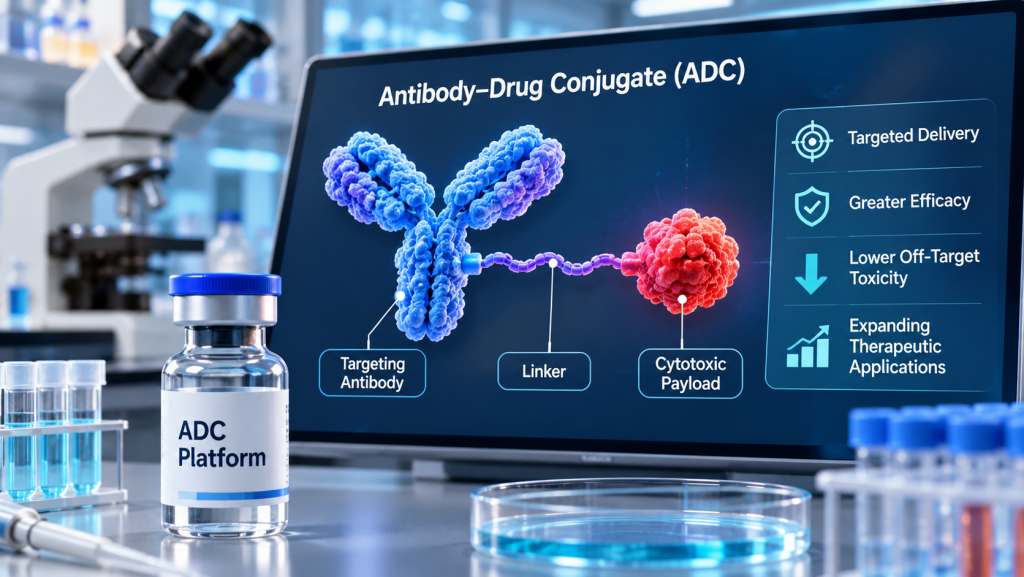
There has been rapidly increasing interest in ADC (antibody-drug conjugates) technology as a number of antibody-drug conjugates have become commercially successful. This has generated significant interest in the enabling technologies for the development of ADCs. The ADC technology market is made up of foundational bioconjugation chemistries, next-generation linker designs, antibody engineering innovations, and specialised equipment for manufacturing ADCs.
The ADC technology market includes a range of technologies and platforms to engineer, conjugate, assess, and scale antibody-drug conjugates.
Understanding the Core Components of ADC Platforms
The ADC platform is structured in 3 pillars: targeting antibodies, linkers, and cytotoxic payloads.
The central scientific challenge historically was random lysine or cysteine conjugation, often resulting in a heterogeneous drug mixture with undefined and unpredictable pharmacokinetics.
Now, focus is on site-specific bioconjugation (e.g., engineered cysteines and other non-natural amino acids, enzymatic conjugations) to result in more uniform ADCs with defined payload-to-antibody ratios.
Why the Medical Community Is Paying Attention

Stable and uniform ADCs are produced with advanced bioconjugation techniques. The use of ADCs in the clinic has shown promise, and further applications of the technology are under investigation.
Beyond monoclonal antibodies, platform technologies are advancing to include other constructs including bispecific ADCs and antibody fragment conjugates, as well as other dual-drug delivery systems.
These new platform technologies will enable researchers to target low-level tumor antigens, expanding the opportunities in oncology.
Market Growth Reflects Rising Confidence

Industry projections from market research firm Roots Analysis clearly highlight the momentum behind this technology platform sector. According to their market report, the global ADC technology market reached USD 2.34 billion in 2025. Roots Analysis projects the sector will reach USD 9.51 billion by 2040, expanding at a CAGR of 7.5% during the forecast period. Their insights reflect rising confidence as pharmaceutical majors license proprietary conjugation and linker platforms to accelerate internal drug development pipelines.
Challenges Facing Adoption
- High upfront licensing fees and complex intellectual property landscape surrounding proprietary conjugation platforms.
- Technical complexities in maintaining scale-up stability during site-specific conjugation manufacturing.
- Navigating complex multi-component regulatory evaluation frameworks for novel linkers and engineered scaffolds.
Conclusion
Following the ADC model, targeted biotherapeutics are positioned at the precipice of a renaissance. Recently, several technologies have been developed to create linkers and conjugate biomolecules in a site-specific manner. Companies specializing in these emerging technologies facilitate the development of advanced biotherapeutics, including next generation of cancer therapies.
Please Write Your Comments